
For bloggers and freelancers, the answer is clear: KWfinder.
Ahrefs is a great tool. But it starts at $129/month and most of what makes it so good — its backlink index, its content explorer and its site audit depth — isn't what solo content creators need on a daily basis. KWFinder covers the core use case (keyword research, rank tracking and basic competitor analysis) at $29.90/month. Over a whole year that's a difference of $1,188/year for capabilities that overlap more than Ahrefs' marketing suggests.
With that being said, there are real cases where Ahrefs is the right choice. This article breaks down exactly which tool wins for what.
KWFinder vs Ahrefs at a glance
| KWFinder (Mangools) | Ahrefs | |
|---|---|---|
| Starting price | $29.90/mo (annual) | $129/mo |
| Best for | Bloggers, freelancers, solo SEOs | Link builders, content marketers, agencies |
| Keyword research | Strong, intuitive | Strong, larger database |
| Backlink data | Limited | Industry-leading |
| Rank tracking | Included (SERPWatcher) | Included |
| Site audit | Basic | Comprehensive |
| Free trial | Yes — no credit card | No (Webmaster Tools only) |
| Tools included | 5 (KWFinder, SERPChecker, SERPWatcher, LinkMiner, SiteProfiler) | All-in-one platform |
KWFinder (Mangools)
KWFinder is one of the tools the Mangools subscription offers — five dedicated SEO tools bundled into one. It covers keyword research, SERP analysis, rank tracking, backlink checking and domain profiling.
What it does well
The keyword difficulty scores are the headline feature. They are displayed in color codes from green (easy) to red (hard), which sounds simple but matters more than you would think when you’re scanning a long list of keyword ideas looking for a starting point. The accuracy at the lower end of the scale — the 0–35 range where new sites actually have a chance is solid.
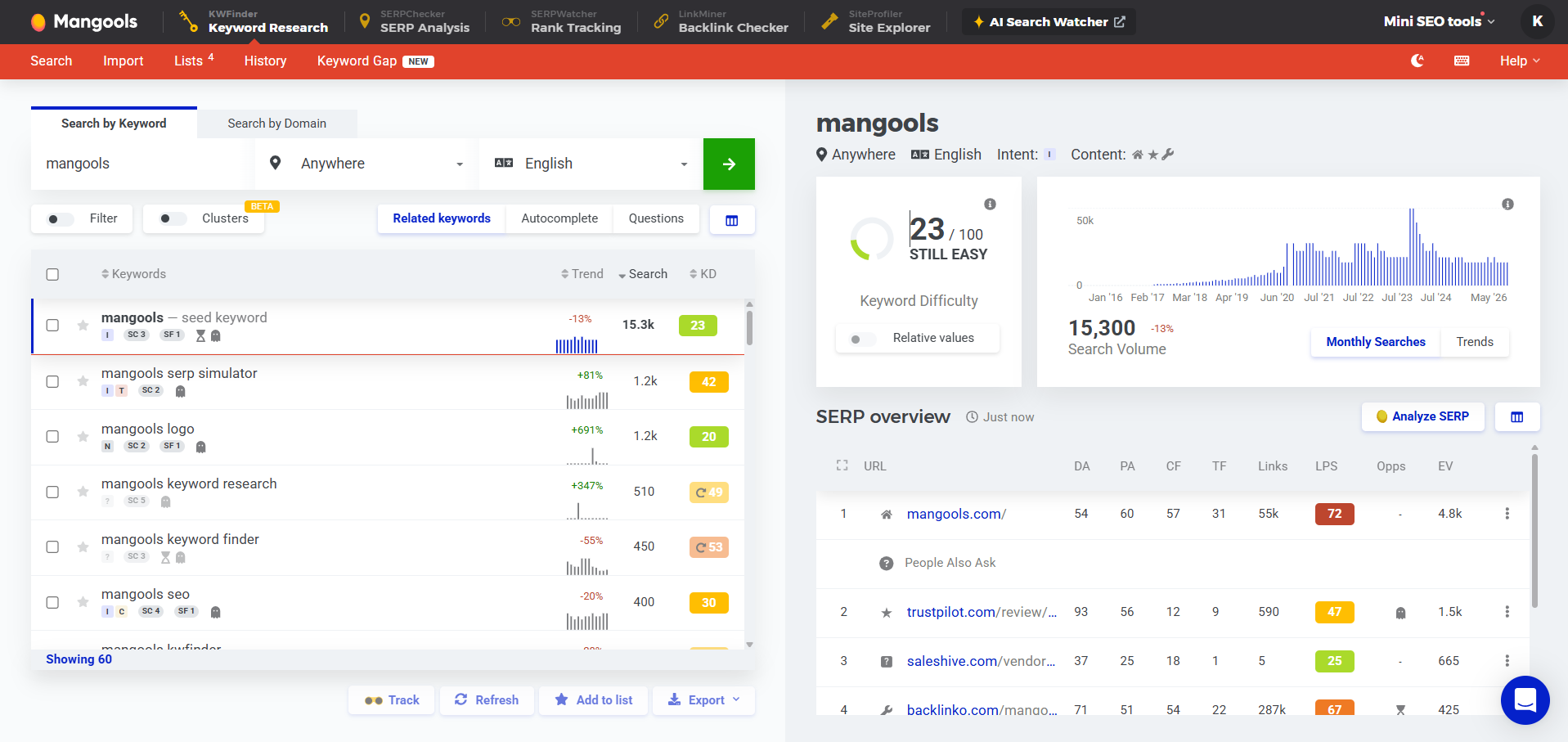
The interface is easy to pick up. You run a keyword, you get a list, you click into a SERP view on the right panel. There is no dashboard sprawl, no six-tab onboarding sequence. If efficiency and simplicity is what you value, this offers great value for money.
SERPWatcher, the rank tracker, is cleaner than most. The Dominance Index metric — which factors in position, search volume and CTR together — gives you a single number that reflects traffic potential rather than just position. That's a better summary than “you're at position 14” with no context.
Where it falls short
Its backlink data is insufficient. LinkMiner exists and works for basic checks, but if link building is an essential part of your strategy, you'll feel the gap quickly. The index is smaller and the data less fresh than what Ahrefs or even Moz serve.
There's no Content Explorer equivalent. If you want to find what's performing in your niche based on backlinks or social shares, Mangools doesn't have that.
Site audits are functional, but not deep. For technical SEO work beyond surface-level checks you'll need a different tool.
Pricing
- Basic: $29.90/mo (annual) — 100 keyword lookups/day, 200 SERP lookups/day, 1 seat
- Premium: $44.90/mo (annual) — 500 keyword lookups/day, 3 users
- Agency: $89.90/mo (annual) — 1,200 keyword lookups/day, unlimited users
All plans include access to all five tools. There is no feature gating by tier, only usage limits.
Try it for free: mangools.com
For a deeper look at what the full Mangools subscription covers, check out the KWFinder review.
Ahrefs
Ahrefs is known for one thing: backlink data. Its index is one of the largest and freshest available, and people serious about link building use it for good reason. Over the years it's expanded its offering to cover keywords, content research, rank tracking and site audits, all at a high level.
What it does well
The backlink data is among the best in the industry at its price point. It is fresh, comprehensive and well-organized. If you're doing outreach, analyzing your competitors, or trying to understand why a page ranks despite its lack of content, Ahrefs gives you answers in a way that other tools can't.
The Keyword Explorer is strong. The traffic potential metric — which estimates total traffic based on clicks the top-ranking page gets across all its keywords — prevents you from writing for a 2,000/month keyword that's lost most of its traffic to variants you didn't check.
Content Explorer is another area where it excels. You can search any topic and filter top-performing content by backlinks, traffic or social shares. For content research and link prospecting, it has no real equivalent in its price range. Nuwtonic's breakdown of Ahrefs vs KWFinder covers this distinction well if you want a second opinion.
Where it falls short
The price is $129/month and thus hard to justify for a blogger or freelancer who only needs keyword research and rank tracking.
There is no free trial in the traditional sense. Ahrefs Webmaster Tools gives you free access to site audits and backlink data for domains you own, which is genuinely useful. But you can't evaluate the tool properly before committing to a subscription.
The interface has improved but can still feel heavy when you just want to run a keyword and move on.
Pricing
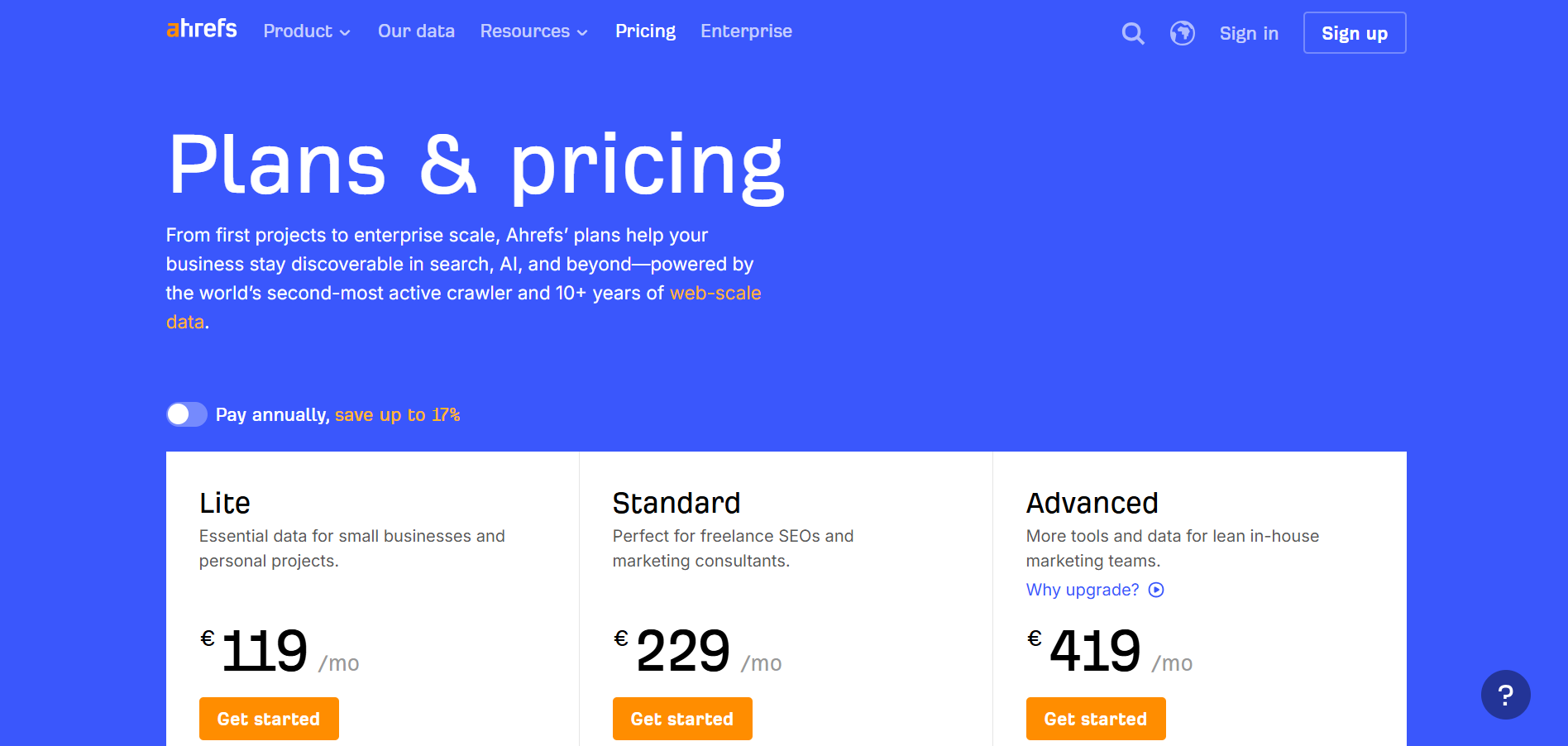
- Lite: $129/mo — 5 projects, 6 months of history
- Standard: $249/mo — 20 projects, 2 years of history
- Advanced: $449/mo — 50 projects, 5 years of history
- Enterprise: $1,499/mo
Head-to-head
Keyword research & KD scoring
Both tools do keyword research well. The meaningful difference is in how they score difficulty.
Ahrefs' KD is based on the number of referring domains pointing to top-ranking pages. It's transparent and respected. KWFinder's KD uses a mix of link profile quality alongside raw link count — producing more conservative estimates at the easy end, which is slightly more useful for a new site picking its battles carefully.
In practice you'll often see KWFinder show KD 18 where Ahrefs shows KD 12. Neither is wrong — they're measuring slightly different things. What matters is both are in the “easy” range, and KWfinder's color coding makes that immediately obvious.
Backlink data
When it comes to backlink data, Ahrefs has no contest. Its index is larger, updated more frequently, and the interface for exploring link data — anchors, referring pages, link type, dofollow/nofollow split — is more complete.
KWFinder's LinkMiner handles basic backlink checks fine. You can see who links to a competitor, filter by authority, spot broken links. For lightweight competitor research it gets the job done. Up North Media's comparison goes deeper on the backlink data gap if that's your main concern.
For active link building campaigns, outreach at scale and gap analysis, you'll want Ahrefs.
Price vs value for bloggers
This is the crux of the comparison for most people reading this.
KWFinder's Basic plan at $29.90/month gives you keyword research, SERP analysis, rank tracking, basic backlink checking and domain authority metrics. For a blogger publishing two to four articles a month and tracking 20–30 keywords, that's everything you need.
Ahrefs at $129/month gives you all of that plus significantly better backlink data, Content Explorer and a deeper keyword database. If you're using those features then you're getting a good deal, but most solo bloggers aren't.
The question isn't “which tool is better.” Ahrefs is the better tool — that is a fact. The question is whether the extra capabilities justify the $1,188/year more in subscription cost for your specific use case. For most bloggers and freelancers, it doesn't.
Who should choose which
Choose KWfinder if:
- You're a blogger, freelancer, or solopreneur focused on organic SEO
- Keyword research and rank tracking are your core needs
- You want a tool you can learn in a day and use in 20 minutes a week
- Budget is a real consideration ($29.90 vs $129 matters to you)
- You don't run active link building campaigns
Choose Ahrefs if:
- Link building is a core part of your strategy — not occasional but regular
- You do content research at scale and need Content Explorer
- You're an SEO consultant or agency handling multiple clients
- You need the deepest possible keyword database for a large site
- The extra $100/month is justified by the work you're billing against it
There is also a middle path: start with KWfinder, use the free Ahrefs Webmaster Tools for your own site's backlink data, and upgrade to Ahrefs when you hit the ceiling on what KWfinder can tell you.
Conclusion
KWFinder is the right tool for most professionals comparing the two. It's not a budget compromise but a focused tool that does what most bloggers and freelancers actually need, without the feature overhead that drives up Ahrefs' price.
If you run serious link building campaigns or need Content Explorer for content research at scale, Ahrefs earns its cost. Otherwise you're paying for features you don't use.
For a broader look at how KWfinder fits alongside other SEO tools at different price points, the SEMrush alternatives comparison covers seven tools across different budgets and use cases.