
Comparing Mangools vs SEMrush usually comes down to one question: do you need everything SEMrush offers, or just the SEO fundamentals? SEMrush is undoubtedly the bigger platform. It bundles in PPC research, content tools and a keyword database that outsizes most of its competitors. Mangools does one thing, and it does it well: SEO. Keyword research, rank tracking, backlink checks and SERP analysis.
If you’re a solo blogger or freelancer, that’s not a weakness. It’s the selling point.
Quick picks:
- Best for solo bloggers and freelancers: Mangools
- Best if you also run paid ads or need content tools: SEMrush
- Cheapest option: Mangools, by a wide margin
Mangools vs SEMrush, the basics
| Tool | Starting Price | Best For |
|---|---|---|
| Mangools | $29.90/mo (annual) | Freelancers, bloggers, solo SEO work |
| SEMrush | $117.33/mo (annual) | Agencies and teams running SEO + PPC together |
Same billing cycle, real numbers. SEMrush costs roughly four times as much to get started.
Mangools: the focused option
Starting price: $29.90/month (annual) or $49/month (monthly)
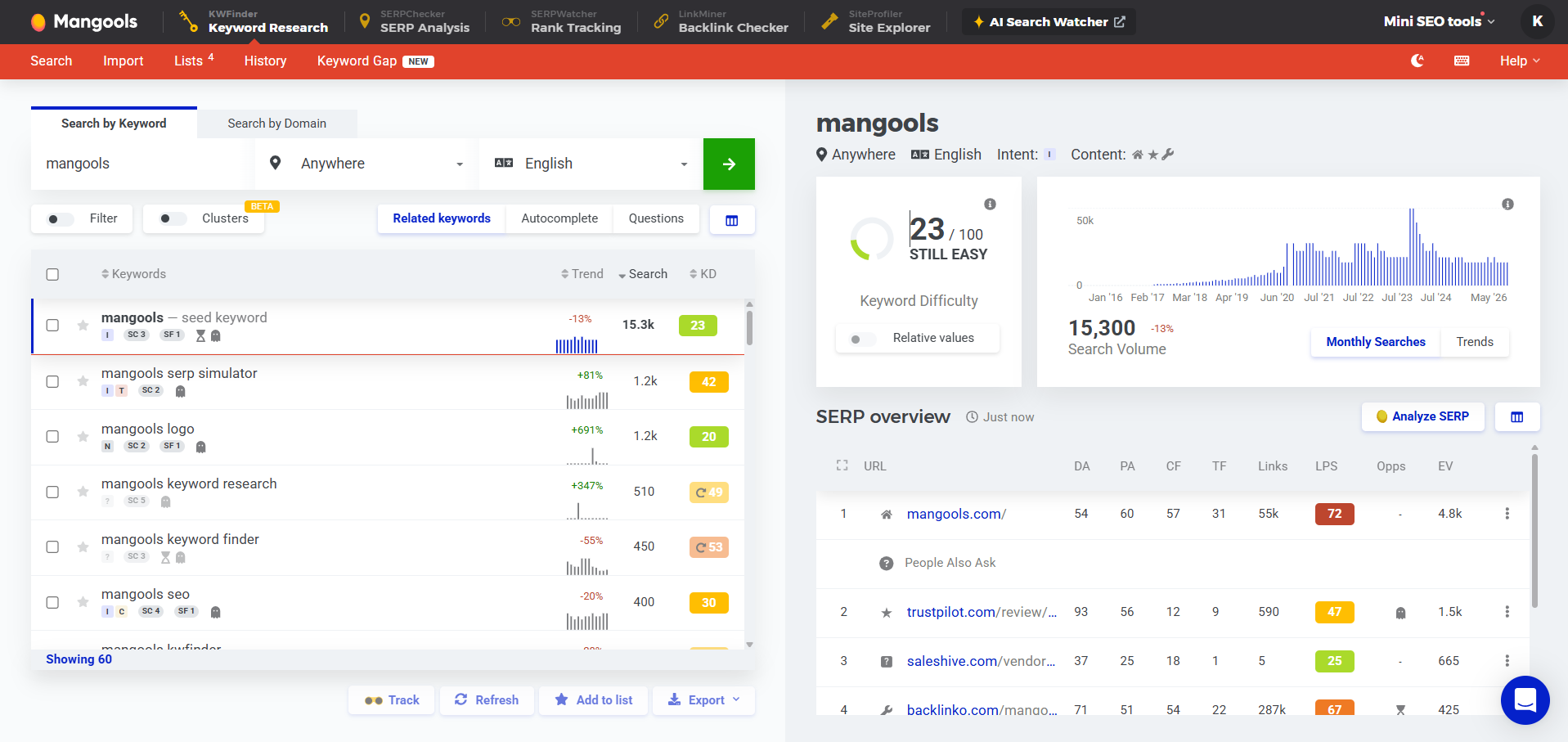
Mangools combines five SEO-specific tools into one platform: KWfinder for keyword research, SERPChecker for SERP analysis, SERPWatcher for rank tracking, LinkMiner for backlinks and SiteProfiler for domain metrics. This is the whole package, so it doesn’t include a PPC module or a content marketing dashboard.
Why is this good for you? Speed and simplicity. You open KWfinder, you find your keywords and you’re done. There’s no sprawling navigation bar with 40 features you don’t need. For a full breakdown of what KWfinder gets right, and what it gets wrong, see our dedicated KWfinder Review 2026.
Where it falls short
No PPC data. No content marketing suite. If your work requires paid ads or content-focused features, Mangools isn’t the right tool for you.
Best for: freelancers and solo bloggers who want accurate keyword difficulty scores and rank tracking without paying for features they’ll never use.
Price isn’t the only factor. Whether it fits your actual workflow matters more.
SEMrush: the full suite
Starting price: $117.33/month (annual, entry-level SEO tier) or $139.95/month (monthly)
SEMrush’s entry-level tier already bundles in keyword research, site audits, backlink analysis, competitor tracking and content tools. Higher tiers add newer AI Search visibility tracking on top. This platform is built for people who need the whole picture, not just organic, but paid and content too.
That breadth is real. The Content Explorer feature alone will justify the price if that’s your niche. So does the sheer size of the keyword database. SEMrush indexes more terms than Mangools does. That matters when you’re working in a highly competitive or highly unusual niche.
Where it falls short
Most of what you’re paying for will go unused if you’re a solo marketer doing organic SEO. You don’t need PPC competitor data if you don’t run ads. And you don’t need enterprise reporting if you’re your own client.
Best for: agencies and in-house marketing teams running SEO and PPC together, or anyone who needs SEMrush’s content research tools specifically. See SEMrush’s current pricing for the latest tier breakdown.
Head-to-head: 4 things that actually matter
Price
Mangools is the obvious winner here. $29.90/month gets you all its features. SEMrush’s entry tier runs $117.33/month on the same annual billing, nearly four times more. If budget is the deciding factor, the choice is clear.
Keyword research depth
This is closer than the price gap suggests. SEMrush’s keyword database is larger and its Keyword Magic Tool surfaces more long-tail variations. But KWfinder’s difficulty scores are more accurate at the low-to-medium range, which is exactly where a new or growing site should be targeting keywords anyway.
One independent test shows the size gap concretely: filtering SEMrush’s Keyword Magic Tool for a single seed term under 20% difficulty returned around 110 keyword ideas. Running the same filtered search through KWfinder surfaced only 3. That’s not a knock on KWfinder’s data quality, it’s a reminder of how much wider SEMrush’s raw keyword index is. So for raw volume, SEMrush wins. For trustworthy difficulty scoring on realistic targets, Mangools has the edge.
Backlink data
SEMrush’s backlink index is bigger and gets updated more frequently than LinkMiner’s. If competitive backlink analysis is central to what you do, SEMrush serves you better here. Mangools’ LinkMiner covers the basics, enough to check your own site’s profile and do some light competitor research. It won’t replace a dedicated tool like Ahrefs or SEMrush for serious link building research.
For a closer look at how Mangools’ own keyword tool stacks up specifically against Ahrefs, see our KWFinder vs Ahrefs comparison.
Ease of use
Mangools is built for speed and simplicity. Five tools, one job each, minimal learning curve. SEMrush’s depth and breadth means a steeper learning curve before you can use it efficiently. New users often find themselves ignoring 80% of the platform just to get to the keyword tool.
Who should choose which
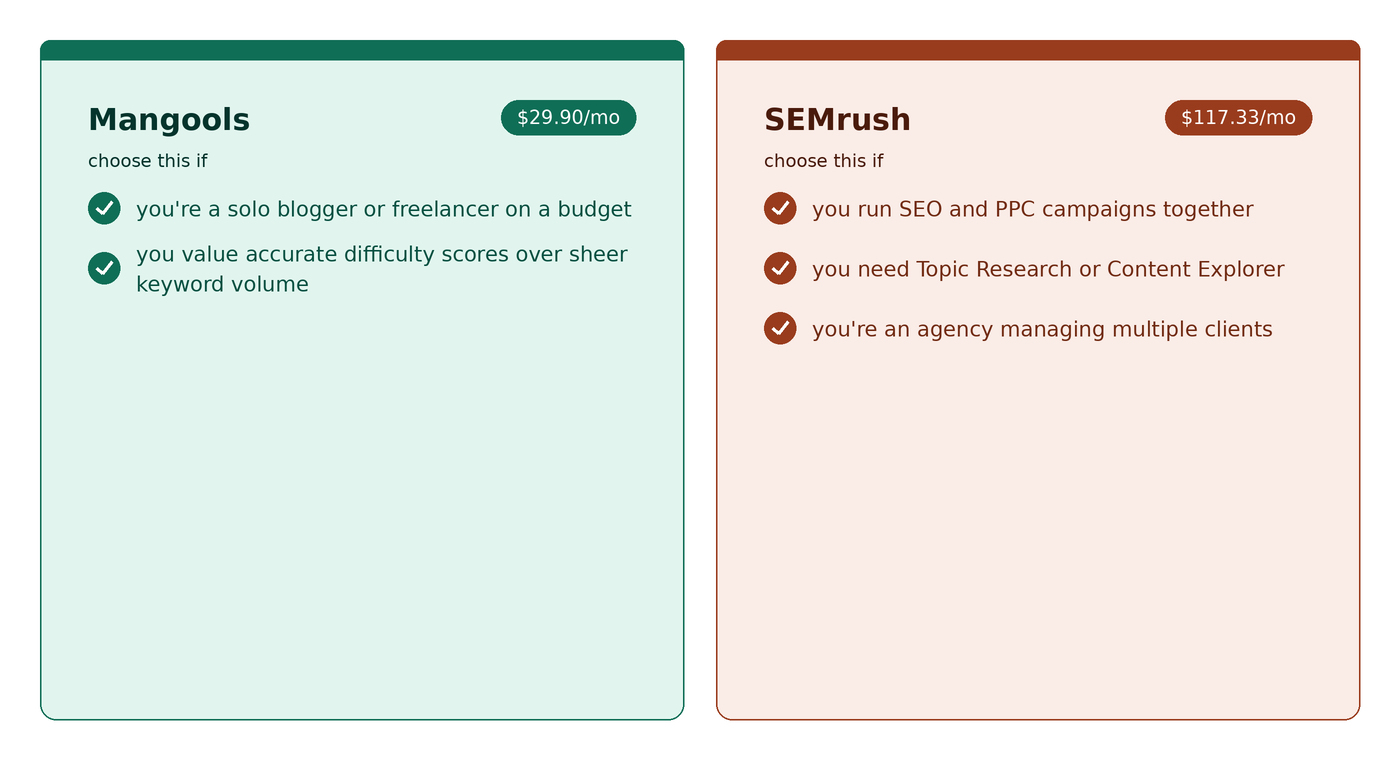
- You’re a solo blogger or freelancer on a budget → Mangools, you’ll use the tools you pay for.
- You run both SEO and PPC campaigns together → SEMrush, Mangools doesn’t touch paid search at all.
- You need content research tools like Topic Research or Content Explorer → SEMrush.
- You value accuracy over volume → Mangools.
- You’re an agency with multiple clients → SEMrush’s broader tooling and reporting depth will come in handy.
For a lower-cost roundup that includes both tools alongside a couple of other options, check our SEMrush alternatives breakdown.
SEMrush vs Mangools: does order matter?
Searching “SEMrush vs Mangools” instead of the reverse doesn’t actually change the comparison. It’s still the same two tools with the same price gap and the same feature trade-off. If you found this page, the conclusion below applies regardless of which tool you typed first.
Conclusion
For most people reading this, solo bloggers, freelancers or small teams doing organic SEO, Mangools is the better call. You’re not paying for PPC tools or a full content suite you won’t open, and KWfinder’s difficulty scores are reliable exactly where you need them: low-competition, realistic keyword targets.
SEMrush is only worth it if you’re running paid ads alongside organic SEO work, if you need SEMrush’s content tools specifically, or if you’re an agency with multiple clients that needs the reporting depth. For everybody else, that difference in price goes unused.
Frequently Asked Questions
It depends on what you’re doing. For solo SEO work, keyword research, rank tracking, backlink checks, Mangools covers everything at a fraction of the cost. SEMrush is better if you also run PPC campaigns or need its content research tools. Most freelancers and bloggers don’t need SEMrush’s extra scope.
If you’re only using SEMrush for organic SEO, keyword research, rank tracking, backlinks, switching to Mangools can cut your bill by roughly $87/month without losing much functionality. You’ll lose PPC data and content tools, so check first whether you actually use those features.
Mangools is five focused SEO tools in one platform. SEMrush is a broader suite that adds PPC research, content marketing tools, and a larger keyword database on top of SEO basics. The difference is scope, not just price. SEMrush does more, Mangools does SEO specifically, and does it simply.
Mangools. Its Basic plan starts at $29.90/month billed annually. SEMrush’s entry SEO tier costs $117.33/month on the same annual billing, close to four times as much. Even SEMrush’s monthly plan at $139.95 costs more than Mangools’ monthly option at $49.
Freelancers, bloggers, and solo marketers doing organic SEO work fit Mangools best, they’ll use the whole toolkit without paying for modules they won’t touch. Agencies, in-house teams running SEO and PPC together, or anyone needing SEMrush’s content research tools should stick with SEMrush despite the higher cost.