
Mangools bundles 5 SEO tools into one subscription, and for solo bloggers and freelancers, that bundling is the whole pitch. You’re not paying for a bunch of features you’ll never fully use. You’re paying for keyword research, SERP analysis, rank tracking, backlink checking and competitor benchmarking.
The conclusion up front: if you’re a solo blogger or a freelancer running your own SEO (or a client’s), Mangools does 90% of what the bigger and more expensive competitors do at a third of the price. It’s not built for agencies managing dozens of accounts and it won’t touch your PPC data. But for organic SEO its price-to-quality ratio is hard to beat.
| Starting price | $29.90/mo (Basic, billed annually) |
| Best for | Solo bloggers, freelancers, small marketing teams |
| Tools included | KWFinder, SERPChecker, SERPWatcher, LinkMiner, SiteProfiler |
| Free trial | Yes, 10 days, no credit card required |
| Not great for | Agencies at scale, PPC research, technical site audits |
What's actually in the Mangools suite
Mangools isn’t one tool wearing five hats. It’s a platform that has five tools for specific use cases. That’s worth knowing going in, because it changes how you’ll use it day-to-day: you’re switching tabs, not scrolling through one big dashboard.
KWFinder: keyword research
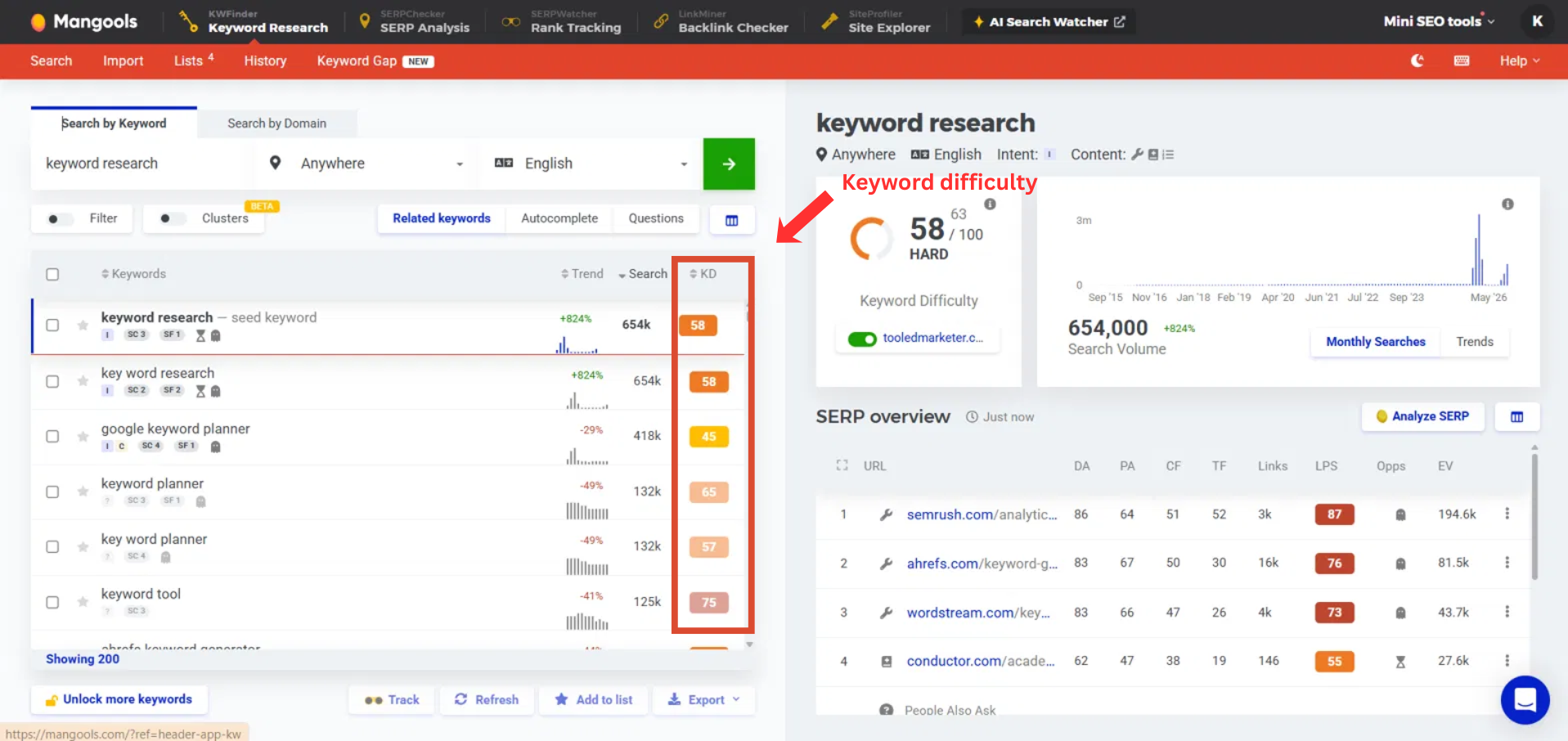
This is the tool most people sign up for. KWFinder finds long-tail keyword variations, it pulls their monthly search volume and keyword difficulty on a 0-100 scale. The keyword difficulty scores are conservative compared to some other competitors, which is actually a good thing. This makes sure that you don’t chase keywords that look easy on paper, but have a SERP that makes it impossible to rank.
We’ve covered KWfinder in a full standalone review if you want a deep dive on it: KWfinder Review 2026.
SERPChecker: SERP analysis
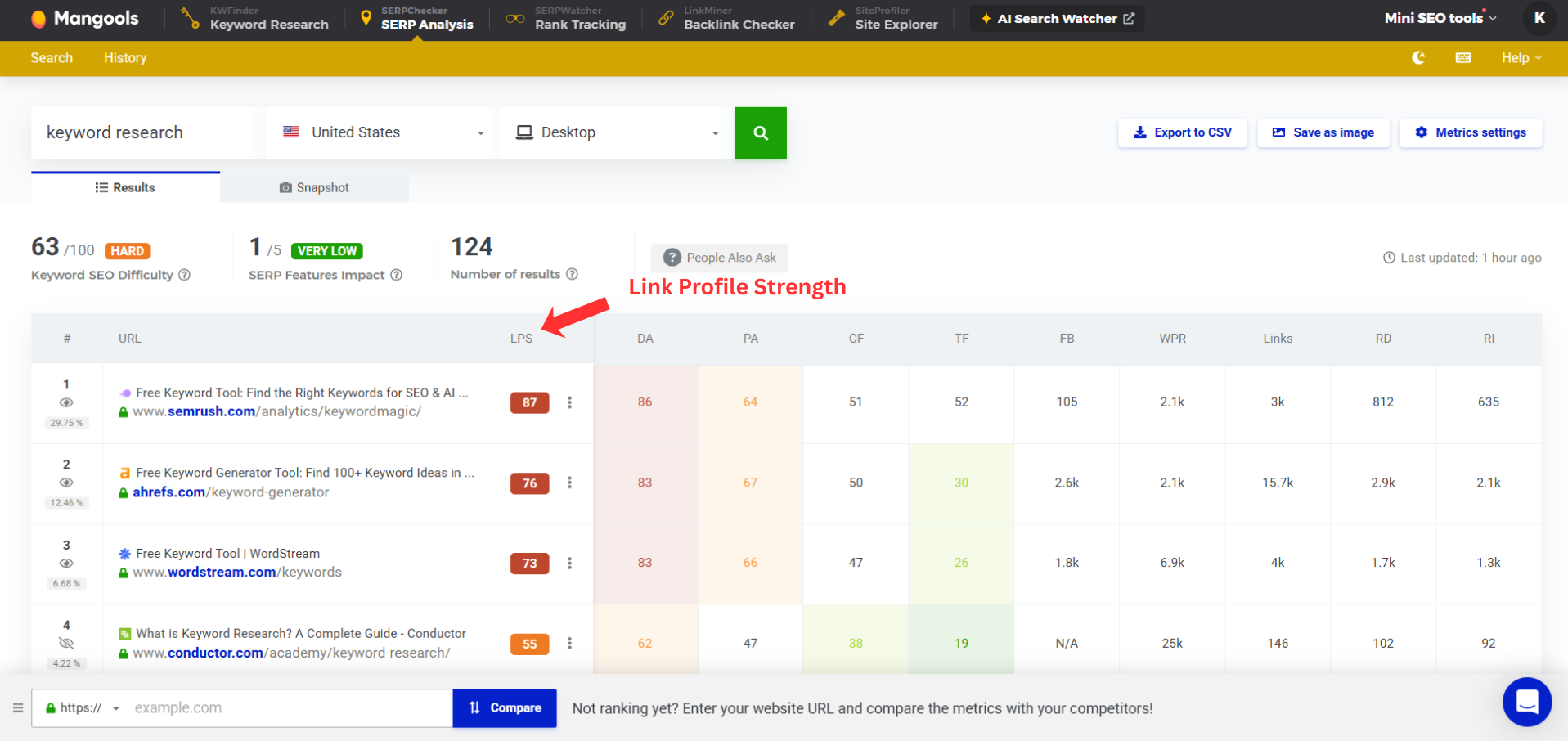
SERPChecker shows you exactly who you’re competing against for any given keyword: it tells you their domain authority, page authority, amount of backlinks and a proprietary “LPS” (Link Profile Strength) which is a score that estimates how hard a specific page will be to outrank. This is the tool that stops you from writing content with keywords where the SERP is too competitive.
SERPWatcher: rank tracking
A clean, visual rank tracker. You simply add your target keywords and SERPWatcher shows their daily position changes with a visibility score that rolls everything into one trend line. This won’t be better than a dedicated enterprise rank tracker when it comes to volume of keywords that it tracks, but for a solo site with a few dozen target terms, it’s more than enough.
LinkMiner: backlink analysis
LinkMiner checks your backlink profile (or that of a competitor) and flags any broken backlinks. A backlink is classified as broken when it points to a page that no longer exists. This is useful, because when you find a site that already links to a dead page on a competitor’s domain, this gives you a warm outreach target for your own content.
SiteProfiler: domain metrics
A quick-glance tool that you can use to check domain authority, traffic estimates and top keywords for any site. This is useful for vetting guest post opportunities or sizing up any competitors before you commit to targeting their keywords.
What Mangools does well
The learning curve is short. Each tool does one job. You’re not going through a large and complicated menu to find a keyword difficulty. It’s the second column you see. For someone that is new to SEO, this matters much more than a tool’s raw feature count.
KD scores hold up. In practice, KWfinder’s difficulty scores track closely with how hard the keywords actually turn out to be. This is not a given across the industry, some tools inflate or deflate KD in ways that only show up once you’re a couple of articles deep into a bad keyword.
The price-to-quality ratio is unmatched. You’d need to combine several free tools, or pay Ahrefs or SEMrush to replicate what Mangools gives you for $29.90/month. For a blog that isn’t generating affiliate revenue yet, this matters.
Worldwide and localized search data. You can pull a keyword’s global search volume or choose to narrow it down to a specific country. A useful feature when you’re writing for a country’s specific audience.
Where it falls short
Mangools doesn’t provide PPC data and is not a content marketing tool. It also does not have a technical site audit feature. So if you’re running paid ads alongside SEO, you’ll need a second separate tool for that.
The backlink index (via LinkMiner) is smaller than Ahrefs’ or SEMrush’s equivalent. It is good enough for checking your own site’s backlinks or to do a quick competitor check, but it’s not what you would need if link building is at the core of your SEO strategy.
Team collaboration is also limited, even on higher tiers. Mangools is primarily built for solo operators and smaller teams. Not for agencies juggling many clients at once.
KWFinder’s keyword difficulty score can also shift right after you click into a term. It loads at one KD, then sometimes refreshes to a different (often higher) one once it recalculates, a quirk one long-time user documented in detail after six months of daily use.
And if you’re planning to test it before committing, know the free trial’s usage caps are tight: one independent review found you’re limited to 5 keyword searches and 10 tracked keywords a day, enough to get a feel for the tool but not to run a real project on.
Mangools pricing breakdown
| Plan | Price (annual) | Price (monthly) | Best for |
|---|---|---|---|
| Basic | $29.90/mo | $49/mo | Solo bloggers, freelancers |
| Premium | $44.90/mo | N/A | Up to 3 seats, better limits |
| Agency | $89.90/mo | N/A | High-volume, team access |
Annual billing can cut the monthly price that you end up paying by 40% compared to paying monthly. This is the right plan for you if you’re sure that Mangools matches your needs. All plans include all the tools, with the only difference being the limits (keyword lookups, tracked keywords, backlink checks) and seat count.
Is Mangools better than Ahrefs or SEMrush?
Not when you consider raw data depth. Ahrefs’ backlink index and SEMrush’s content tools both go quite a bit deeper than anything that Mangools has to offer. But that’s not the comparison that will be the most important for most of you who are reading this.
For a solo blogger doing keyword research, SERP analysis and basic rank tracking, Mangools covers everything that your actual workflow requires at a cheaper cost. You’re not paying for PPC tools you’ll never open or a technical audit you’ll never perform. If your SEO work is organic-only and budget is a consideration, Mangools wins this on value alone, even if its specs are not as impressive.
Conclusion
Mangools is the right tool for you if you’re a solo blogger, freelancer, or part of a smaller team doing organic SEO work and not in need of PPC data or enterprise-scale backlink analysis. The five tools that Mangools has will cover your standard workflow: finding keywords, checking the SERP, tracking rankings, auditing backlinks and sizing up competitors without the price tag or learning curve that Ahrefs or SEMrush come with.
If you’re an agency managing dozens of client accounts or if link building is at the center of your strategy, other tools would suit you better.
If Ahrefs specifically is what you’re weighing Mangools against, our KWFinder vs Ahrefs comparison breaks down exactly where each one wins.
Frequently Asked Questions
Yes. Each tool in the suite does one job, so there’s no hunting through nested menus to find what you need. KWFinder shows keyword difficulty as the second column you see, and SERPChecker’s SERP breakdown is readable without prior SEO experience. It’s one of the more approachable toolsets for someone just starting out.
Not a permanent free plan, but there’s a 10-day free trial with full access to the suite and no credit card required. That’s enough time to run real keyword research for an upcoming article and see whether the workflow fits before paying anything.
KWFinder’s KD scores track closely with real-world ranking difficulty in practice. They tend to run conservative rather than inflated, which keeps you from chasing keywords that look easy on paper but have a locked-down SERP underneath. It’s one of the more trustworthy KD metrics at this price point.
For raw data depth, no. Ahrefs’ backlink index and content research tools go further. For a solo blogger doing keyword research and SERP analysis on a budget, Mangools covers the actual day-to-day workflow at roughly a third of Ahrefs’ price. Which one’s “better” depends entirely on whether you need that extra depth.
Every plan includes the full suite: KWFinder, SERPChecker, SERPWatcher, LinkMiner, and SiteProfiler. The difference between Basic, Premium, and Agency is usage limits (keyword lookups, tracked keywords, backlink checks) and seat count, not which tools you get access to.